Small Things That Make a Big Difference
Building positive relationships with students is about so much more than teaching routines and procedures at the beginning of the school year. It’s about getting to know a new group of children and beginning to build the relationships that will shape your classroom all year long. Each class is its own little family, with its own personalities, dynamics, and interactions. Creating that classroom family doesn’t happen overnight. It takes time, consistency, and lots of little moments of connection.
Here are some of the little things I do to create those connections.
Start With Connection
Connection starts on the first day of school, as soon as the bell rings. Morning time can be one of the most chaotic and hectic times of the day for both teachers and students. Teachers are trying to take care of last-minute preparations while students are arriving with whatever happened before they walked through the door.
Maybe Mom is out of town. Dad got upset because they left late and got stuck in traffic. They had a difficult morning with a sibling. Something happened that we know nothing about.
So many times, we have no idea what has happened before our students get to school. That’s why making a connection as soon as they walk through the door is so important.
- Stand at the door when possible. Put down the last-minute tasks for a moment and be present when your students arrive.
- Greet each student by name. This is also a great opportunity to teach students how to make eye contact, respond, and greet someone who is speaking to them.
- Offer a positive greeting. I like to ask students if they would like a hug, high five, or fist bump. Giving them a choice lets them decide how they want to connect that morning.
- Let students know you’re genuinely happy they’re there. Ask about something you know is important to them: “How did your soccer game go last night?” “I saw your little sister in the hall this morning.” “Did you get a haircut? It looks so cute on you!”
These interactions may only take a few seconds, but they send a powerful message.
I see you.
Learn something about every student
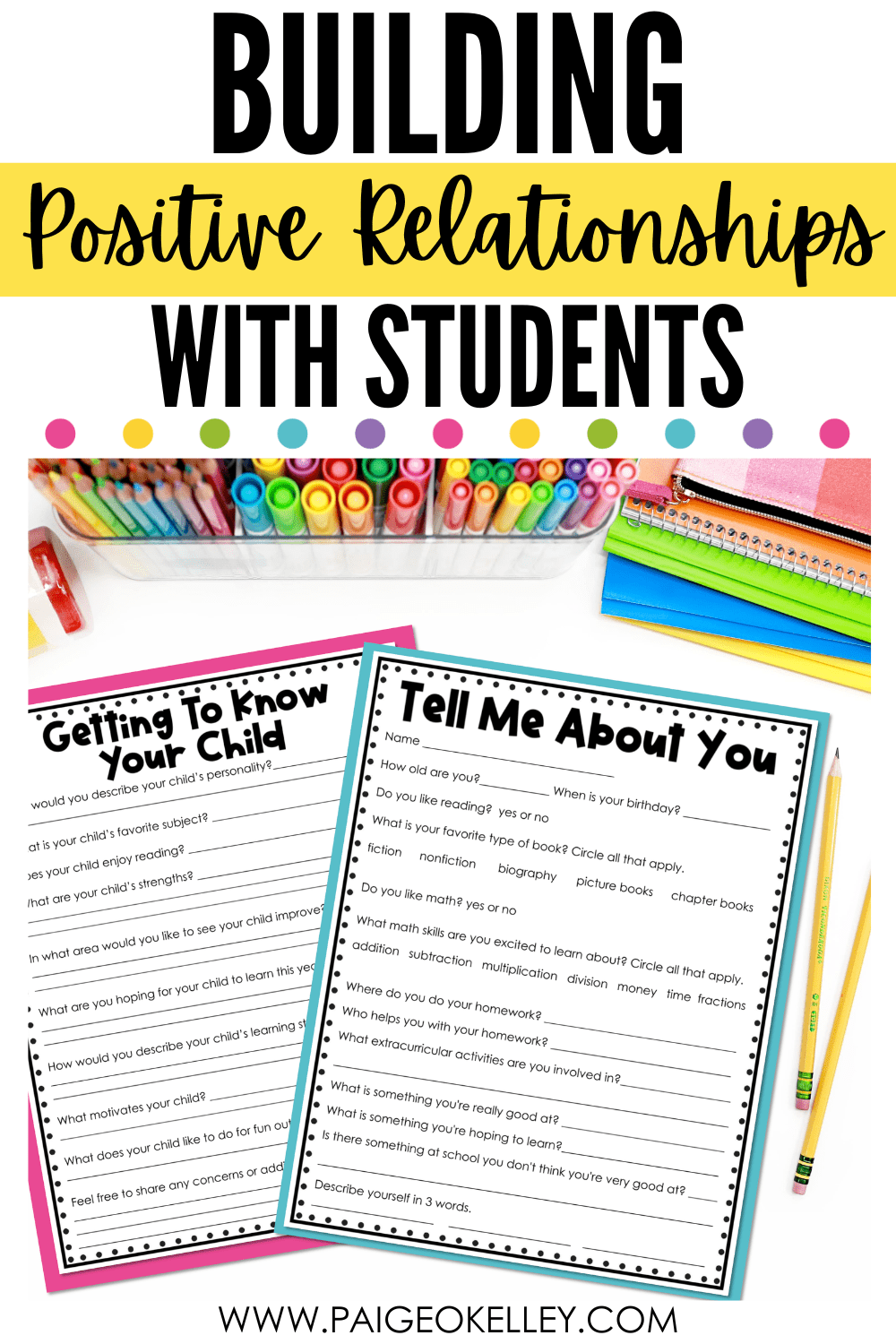
The first homework assignment I always give my students is a questionnaire about themselves. I ask questions such as:
- What is your favorite book and favorite genre?
- Where do you do your homework?
- What extracurricular activities are you involved in?
- What is something you’re really good at?
- What is something you’re hoping to learn?
- Is there something at school you don’t think you’re very good at?

These simple questionnaires help me learn about the interests, strengths, and goals of each student.
I love reading these questionnaires because they immediately give me so much information about each child. When a student tells me they love fiction, I can suggest book series based on their interests. When a student tells me they don’t think they’re good at math, I know I need to look for opportunities to build their confidence and help them see themselves as mathematicians.
And the information isn’t just useful at the beginning of the year. I refer back to it throughout the year and use what I learn to connect with students.
The important part isn’t collecting information. It’s showing students that you cared enough to listen and that you remembered what they told you.
I know you.
Share little pieces of yourself
Just as we want to learn about our students, let them learn a little about you! One of my favorite ways to do this is to make a “Star Student” poster about you, the teacher!

Sharing a few of my favorite things gives students a chance to get to know me, too.
You could include:
- A picture of yourself when you were their age
- Your favorite children’s book
- A picture of your family (they LOVE this one!)
- A funny mistake you made
- Your favorite school supply
- A hobby or favorite activity
Students love learning about their teacher and discovering things they have in common with you. Once students know a little more about you, it becomes easier to make those connections throughout the year.
There is almost always someone in my class who plays basketball, and I love being able to tell them stories about when my son played basketball. If someone is interested in reading the Harry Potter series, I can tell them that it is also my daughter’s favorite series.
My students especially love knowing that my children went to the same school they attend. I’ll tell them funny stories about things my kids said or did when they were in second grade, and they love hearing about them. It never fails that at the first parent conference, parents will repeat stories I’ve told their children and tell me how much their child loves hearing them.
Sharing little pieces of our lives gives students something to connect with. Sometimes that small connection is the beginning of a much stronger relationship.
You know me.
Create Classroom Community With Little Traditions
Some of the best classroom memories come from little traditions that students look forward to each year. These traditions don’t have to be complicated or expensive. In fact, some of the simplest ones can become the things students remember most.
Magic Fairy Dust
Magic Fairy Dust is one of my favorite classroom traditions. Lots of kids (and teachers!) are nervous about the first day of school. At Meet the Teacher, I give each of my students a small bag of Magic Fairy Dust along with a poem. I tell them to put it under their pillow that night to help them sleep well before the first day of school.

Magic Fairy Dust is one of those little classroom traditions my students remember for years.
Magic Fairy Dust is also a fun way to ease test anxiety. Sometimes students don’t need another explanation or one more reminder to study. They just need someone to tell them, “You’ve got this!” This is the special dust we use when we need a little extra courage.
Before a test, I ask students to raise their hands if they would like me to sprinkle Magic Fairy Dust on them. The majority of students usually say yes! I sprinkle a little on their heads and chant, “Magic Fairy Dust, help us work. Help us get our __________ right!” We fill in the blank with whatever we’re working on (spelling words, math facts, science questions, or anything else.)
It’s such a little thing, but it is a tradition my students remember. I can’t even tell you how many former students have told me that they still remember Magic Fairy Dust from second grade, even as adults. I often give each student a second bag of Magic Fairy Dust as an end-of-the-year gift so they can take a little piece of our classroom tradition home with them.
If you use glitter in your classroom, be mindful that not every child or family will be comfortable with it. Ask permission when appropriate, use a very small amount, and keep it away from faces and eyes. You could also use a glitter wand or a special “fairy dust” container if you want the magic without loose glitter.
Class Motto: “Older, Wiser, More Mature”
Choose a simple class motto that you can repeat throughout the year. “Older, Wiser, More Mature” is one of my favorites because it reminds students that as second graders, they are growing in both age and responsibility.

A Special Birthday Tradition
A simple birthday tradition gives students something special to look forward to. It could be a birthday crown, a special chair, a class cheer, a birthday book, or another small tradition that makes each student feel celebrated.
Star Student Compliments
Give students an opportunity to hear something positive from their classmates. A Star Student can receive compliments about kindness, helpfulness, effort, or other positive qualities that classmates have noticed.
One idea is to trace and cut out a large star from butcher paper or construction paper and leave it out with markers for students to write positive messages throughout the week. At the end of the week, send the star home so families can see all of the wonderful things their child’s classmates noticed.
Another idea is to draw a star on the board and have students take turns throughout the week writing a positive remark about the Star Student. At the end of the week, take a picture of the student standing next to the board and email it home. It’s a simple way to make a student feel special while also helping classmates learn to notice and appreciate one another’s positive qualities.

A Class Cheer
Create a special class cheer for those moments when a student accomplishes something difficult. Celebrating together helps students learn to be excited about one another’s successes and creates a classroom where we celebrate effort and growth, not just perfect answers.
Here are a few of our favorites:
- “WOW!” Shape your arms into a capital W, an O, and a W while spelling it out loud, then shout, “WOW!”
- “Kiss Your Brain!” Kiss your fingertips and tap your head.
- “S-E-C-O-N-D… We Will Succeed!” My students LOVE this one!
You can even let your class create its own special cheer. Having a few different cheers gives you something to pull out whenever a student needs a little extra celebration.
Student Shout-Outs or Showcases
Set aside a few minutes during Morning Meeting to recognize students for something positive. A quick shout-out for kindness, effort, improvement, or helping someone else can start the day on a positive note.
One of my favorite ways to do this is to showcase a student’s work. Maybe it was the effort they put into an illustration, the way they explained their thought process on a math problem, or the growth they’ve made over time. I love showcasing growth because it sends the message that I’m paying attention to where each student started and how far they’ve come.
Sometimes the work I’m showcasing isn’t the “best” work in the class. It might be work that shows persistence, improvement, creativity, or a student taking a risk. Those are the moments I want students to know are worth celebrating.
You belong here.
Positive Communication With Parents
Make positive phone calls home.
This is a great relationship-building strategy because it doesn’t cost anything! Try making a goal of calling one family each week simply to share something positive.
It doesn’t have to be a major accomplishment. You might say, “I called because I wanted you to know how kind your child was today.” There are SO MANY parents who rarely, if ever, receive a positive phone call about their child.
That kind of call can completely change the tone of the teacher-family relationship. It also makes it so much easier if and when you need to call about a problem or concern. You have already established trust with the parent or guardian, so they know you are on the same team and that you want the very best for their child.
Email a picture of the child.
Send parents a picture of their child doing something positive at school. It could be a posed picture, but my favorite pictures are the candid ones: a child working independently, reading a book to a friend, helping a classmate, or playing a game with a partner.
I always add a little caption, such as, “She was so excited to read this book today!” Parents LOVE these emails, and I almost always get a response. It’s a quick way to give families a little window into their child’s day and remind them that their child is doing wonderful things at school.
Of course, positive communication doesn’t always have to involve a phone call or an email. Sometimes a little note tucked into a backpack can make just as big an impact.
Send Happy Mail and Positive Notes Home
Positive Notes Home are a simple and meaningful way to build classroom community, support positive behavior, and maintain strong communication with families. You can use them as happy mail, brag cards, or desk notes to recognize effort, kindness, academic growth, and student achievements.

I always keep a Positive Notes Recording Sheet to track when and to whom notes are sent. This helps me make sure positive communication is spread throughout the class and helps me quickly identify students who might be falling between the cracks and aren’t getting noticed as often for their positive behavior.

Sometimes the students who need a little extra encouragement are not the ones who naturally draw our attention. Keeping track of positive notes helps make sure every child has a chance to be noticed and celebrated.
I love having these ready to go because it makes positive communication something I can do consistently throughout the year, not just when a student has a major accomplishment.
Your family matters to me.

Want to make positive communication a regular part of your classroom?
Check out my Happy Mail and Positive Notes Home resource.
Make Students Feel Safe to Learn
Students need to know that your classroom is a safe place to make mistakes, ask questions, try something new, and not have all the answers. If students are worried about being wrong or embarrassed in front of their classmates, they are much less likely to take the risks that are necessary for learning.
Let students know that mistakes are part of learning. When a student says, “I can’t do that,” we rephrase it as, “I haven’t learned that… YET.” That one little word can change the way students think about what they are capable of.
Celebrate students who try a new strategy, explain their thinking, ask a question, or keep working when something is difficult. Don’t only praise the student who gets the correct answer. Many times, I will praise the student who didn’t get the answer correct but kept trying, tried a different strategy, or was willing to share their thinking.
Giving students opportunities to explain their thinking is also an important part of building confidence in math. I love using formative assessment to see not just whether students got the answer right, but how they are thinking about the problem. Learn more about using math assessments to guide instruction.
I also love giving students opportunities to be successful in different ways. A child who struggles with math might be an incredible artist. A student who isn’t confident reading aloud might be an amazing helper or storyteller. Look for those strengths and give students opportunities to shine.
When students know that mistakes are okay and that their teacher believes they can learn, they become more willing to try, take risks, and keep going when learning gets hard.
It’s safe to make mistakes here.
Why Positive Relationships With Students Matter
Teachers spend so much time thinking about lessons, routines, procedures, and classroom management at the beginning of the school year, but one of the most important things we can do is build positive relationships with our students and their families.
Positive relationships with students aren’t built through one big activity. They’re built through the little things we do consistently: greeting students, noticing their effort, celebrating their growth, listening to them, and giving them reasons to feel excited about coming to school.
Before students can fully buy into your classroom and the learning that happens there, they need to know that they can trust you. They are asking themselves:
Can I trust this person?
Is this classroom a safe place?
Does my teacher notice me?
Will my teacher help me when something is difficult?
Will my teacher be there for me?
When students know the answer to those questions is yes, something important happens. They begin to trust you, take risks, accept challenges, and believe that they can be successful.
That’s why the little things matter. The Magic Fairy Dust, the class cheers, the positive notes home, the compliments from classmates, the morning shout-outs, and the quick conversations in the hallway may seem like small moments to us, but they can mean so much to a child.
Positive relationships don’t just encourage students to work hard and do their best. They create the foundation for a classroom where students feel known, valued, and supported.
When we consistently send these messages to our students, something powerful happens. They begin to trust us, take risks, and believe in themselves.
I see you. I know you. You know me. You belong here. Your family matters to me. It’s safe to make mistakes here.
Those may seem like simple messages, but they are the foundation of a strong classroom community.
And sometimes, the relationships we build with our students become the ones they remember for the rest of their lives- not because they remember every lesson we taught, but because they knew we believed in them.
Looking for more ideas for creating a positive, organized classroom? Explore more classroom ideas and teaching tips on the blog.